
Where Data Tells the Story
© Voronoi 2026. All rights reserved.

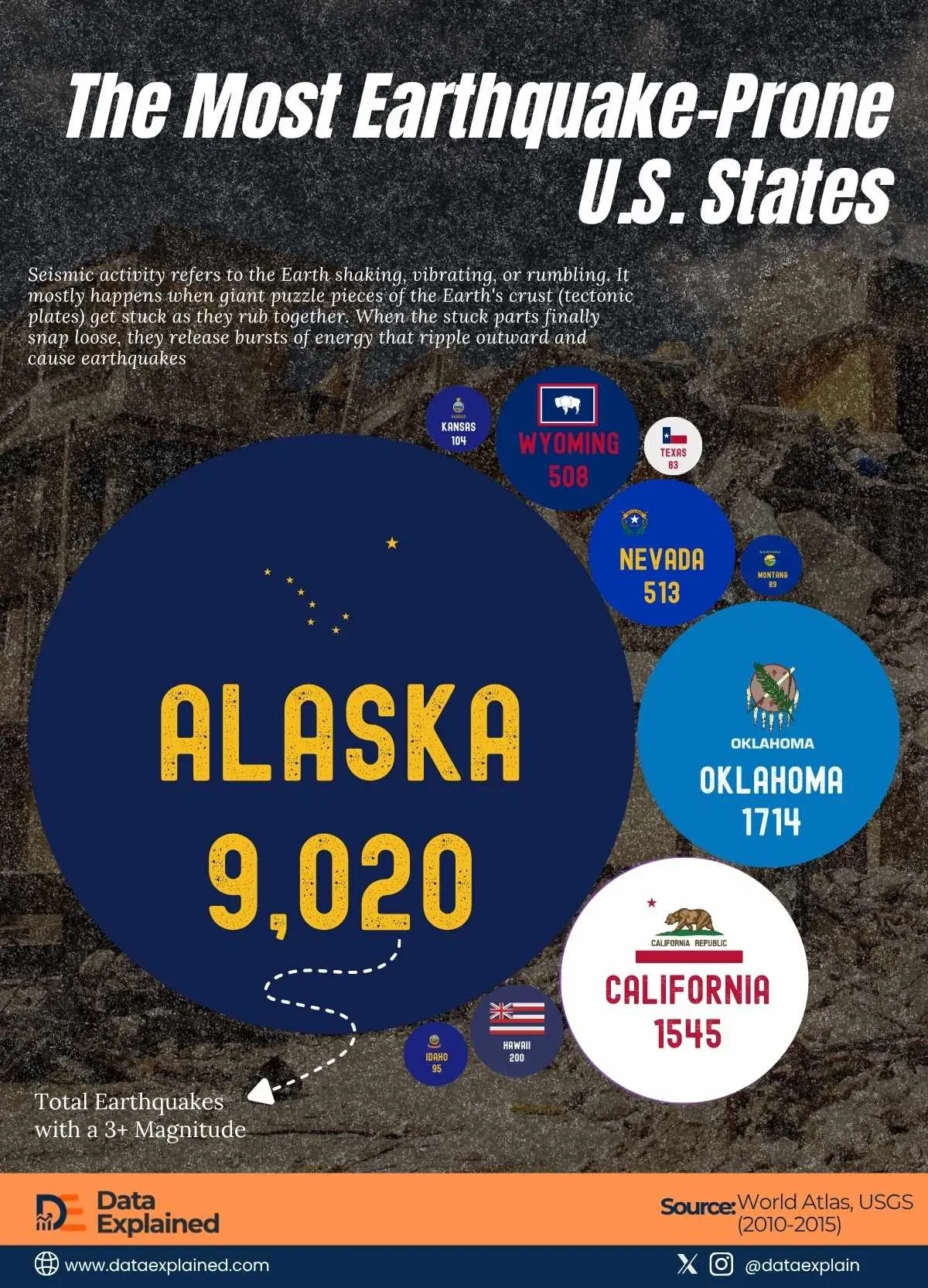
An earthquake-prone state refers to a region or geographical area that has a high likelihood of experiencing significant seismic activity (earthquakes) due to its location near active fault lines or shifting tectonic plates.
According to WorldAtlas, Alaska leads the U.S. in earthquake activity.
It is based on the total number of earthquakes with magnitudes over 3 between 2010 and 2015.
When people think of earthquakes in North America, California is usually the first place that comes to mind. But the data tells a different story.
States like Alaska and Oklahoma experience even more seismic activity. Scientists have recorded thousands of earthquakes with a magnitude of 3.0 or higher.
Alaska tops the list as the most seismically active state in the U.S., with over 9,000 earthquakes.
This is because it lies directly on the Pacific Ring of Fire, where tectonic plates typically collide and subduct beneath one another.
Oklahoma comes next with 1,714 quakes. Although natural plate movements do not cause it, human activity, such as wastewater injection, does.
California, known for the San Andreas Fault, comes third with 1,545 earthquakes. It’s not the highest, but the state’s dense population makes its quakes intense.
The West Coast and Alaska face the most significant natural seismic risks due to their proximity to tectonic boundaries. The quakes in the Central U.S. tell how human activity can also trigger earthquakes.