
China And U.S. Combined Have More Than Half Of The World's Skyscrapers
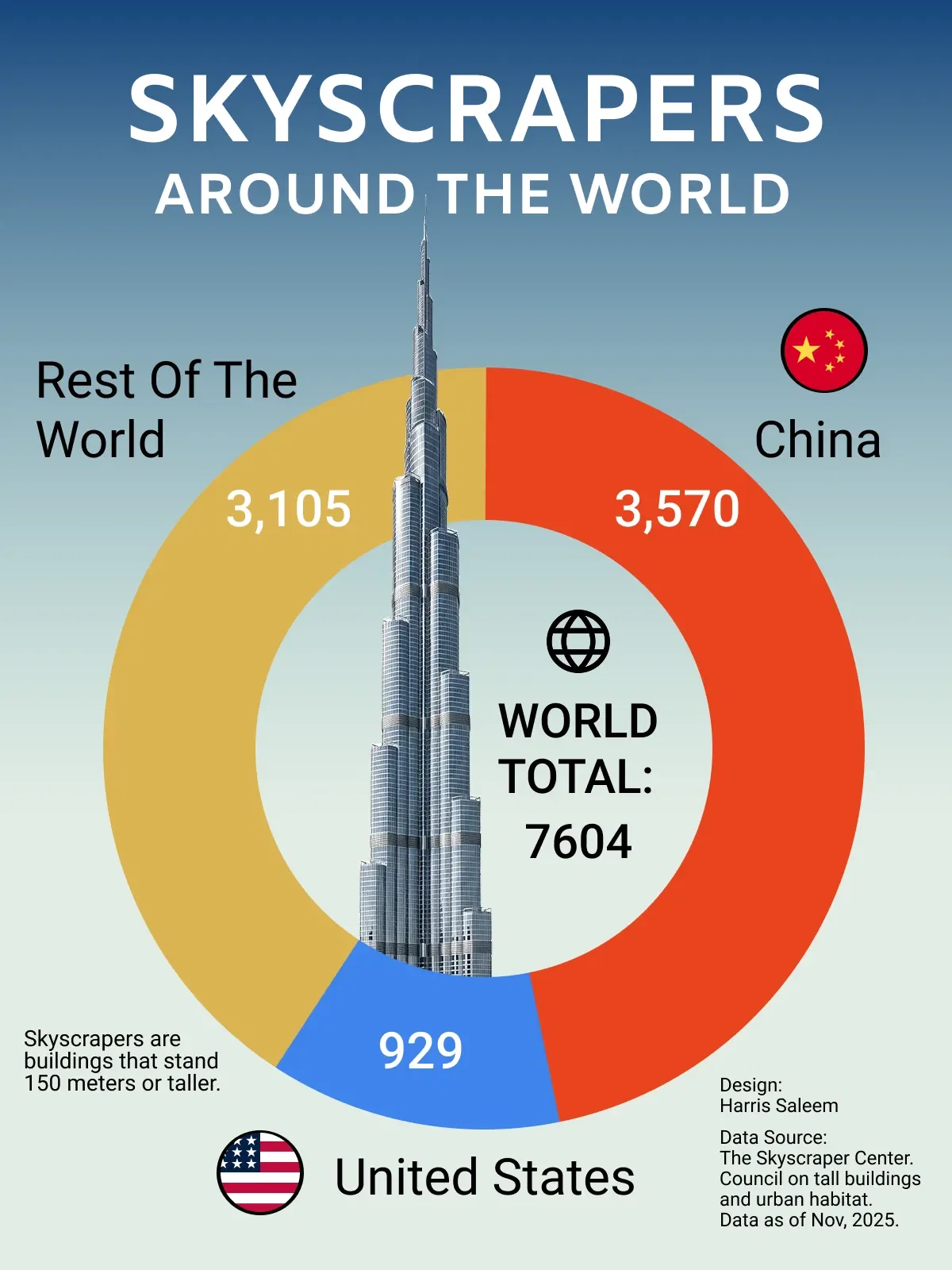
Skyscrapers Around The World
The global skyline continues to climb higher each year, but one country dominates the race for vertical expansion and that is China. Skyscrapers are buildings that stand 150 meters or taller.
This infographic shows the global distribution of skyscrapers as of November 2025, highlighting how a handful of nations have shaped the world’s modern cityscapes.
China Leads the World in Vertical Growth
China stands at the forefront of global skyscraper construction, home to 3,570 skyscrapers which is around 47% of all skyscrapers worldwide. From Shenzhen to Shanghai, the country’s skyline reflects decades of rapid urbanization, economic growth, and massive real estate investment.
The United States Holds Its Place
The United States, often credited with pioneering the skyscraper era, comes second with 929 skyscrapers, accounting for 12% of the world total. Iconic skylines in New York City, Chicago, and Miami continue to evolve, though the pace of new high-rise construction has slowed compared to Asia’s building boom.
The Rest of the World
Outside of China and the U.S., the rest of the world collectively accounts for 3,105 skyscrapers, or 41% of the total. Countries such as the United Arab Emirates (345), Malaysia (327), Japan (284), and South Korea (281) have rapidly expanded their skylines, with global cities competing to redefine modern architecture and urban identity.
Final Remarks
The global skyscraper landscape reflects the shifting centers of economic power and urban growth. While the United States remains an architectural pioneer, China’s sheer scale of construction underscores its dominant role in shaping the cities of the 21st century. As more countries join the race to build upward, the world’s skylines are becoming a powerful symbol of progress, ambition, and modernization.