
Where Data Tells the Story
© Voronoi 2026. All rights reserved.

Vladimir Putin landed in Beijing on Tuesday, May 19, hours after Donald Trump’s departure following his own summit with Xi Jinping last week.
The official occasion was the 25th anniversary of the 2001 Treaty of Good-Neighborliness and Friendly Cooperation.
Analysts describe the significance as running considerably deeper. And the timing, one day after Trump left, is not incidental.
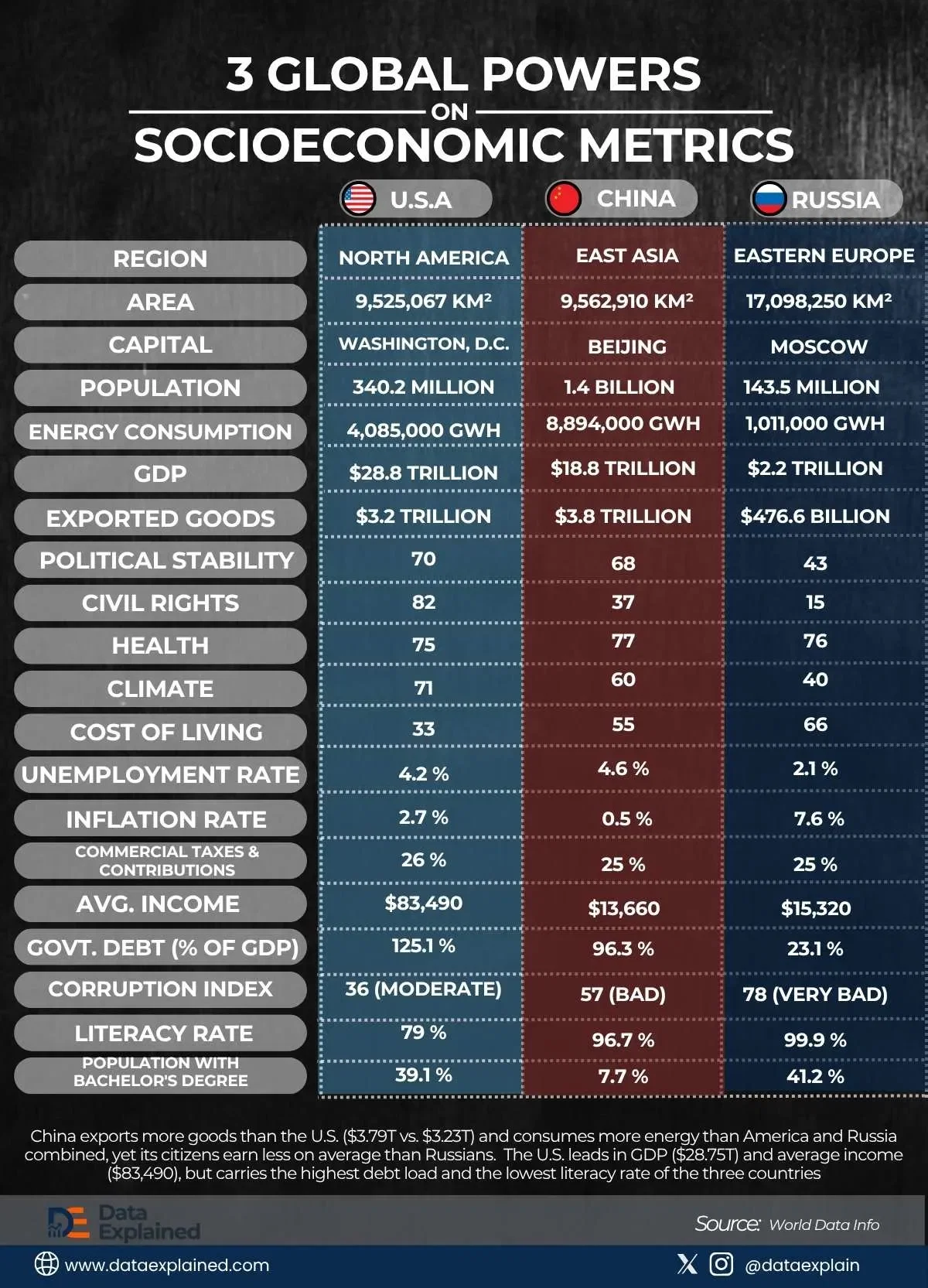
Using the information from World Data Info, the visualization above compares all three countries across 20 socioeconomic metrics.
The data context helps to understand what each leader brings to the geopolitical table.
China is the world’s largest goods exporter, with exports of $3.79 trillion, ahead of the United States at $3.23 trillion.
That single data point frames the entire U.S.-China trade war dynamic.
Trump's tariff regime targets a country that exports more goods than America does. The leverage runs in both directions.
China also consumes more energy than the United States and Russia combined (8,894,000 GWh, compared with the U.S.’s 4,085,000 GWh and Russia’s 1,011,000 GWh).
It reflects the manufacturing intensity of an economy that produces approximately 65% of U.S. GDP but requires 218% of U.S. energy to do so.
Yet Chinese citizens earn $13,660 on average, less than Russia’s $15,320 and a fraction of America’s $83,490.
China’s aggregate economic scale is enormous because of population size (1.409 billion people generating $18.74 trillion in GDP produces a lower per-capita income than 143.5 million Russians generating $2.17 trillion).