
Where Data Tells the Story
© Voronoi 2026. All rights reserved.

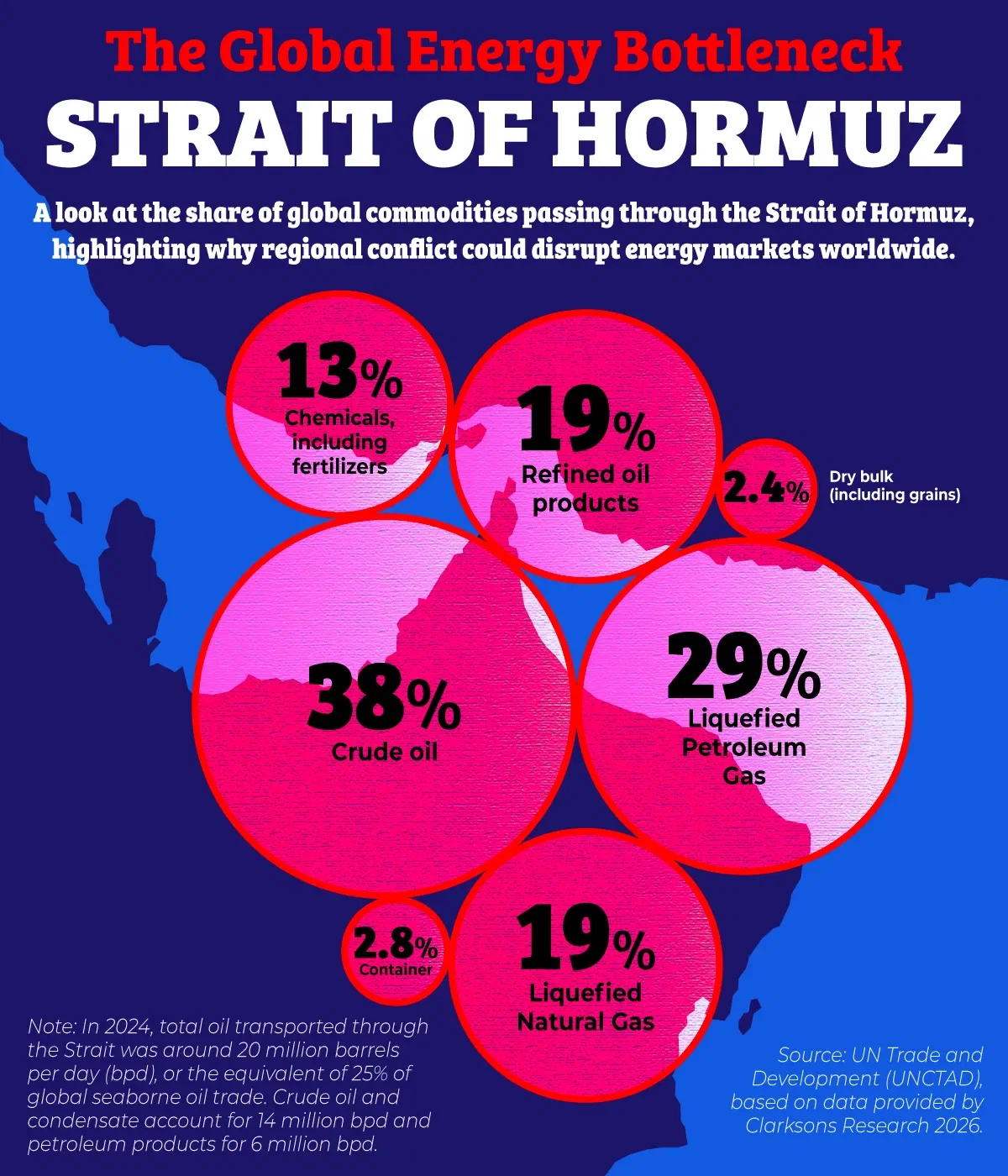
This graphic highlights the share of global commodities that pass through the Strait of Hormuz, one of the world’s most strategically important maritime chokepoints. The visualization shows how different energy and commodity flows rely on the narrow waterway connecting the Persian Gulf with global markets. Commodities are represented by their share of global trade that transits through the strait, illustrating the scale of global dependence on this route.
The data underscores how energy shipments dominate traffic through the corridor, while other goods such as chemicals, containers, and dry bulk commodities also pass through in smaller volumes. Together, the visual illustrates why disruptions in the Strait of Hormuz could have significant implications for global energy supply, commodity flows, and shipping routes.
The figures are based on trade and shipping flow estimates from UN Trade and Development (UNCTAD) using data provided by Clarksons Research.
• Crude oil dominates flows through the strait, with around 38% of global crude shipments passing through the corridor, making it the most significant commodity moving through the route.
• Liquefied petroleum gas (LPG) accounts for 29% of global trade flows through the strait, highlighting its importance for international energy markets.
• Liquefied natural gas (19%) and refined oil products (19%) also represent substantial shares of global shipments moving through the chokepoint.
• Chemicals, including fertilizers, account for 13%, while container trade (2.8%) and dry bulk commodities such as grains (2.4%) represent smaller but notable shares of global trade passing through the Strait of Hormuz.