
Where Data Tells the Story
© Voronoi 2026. All rights reserved.

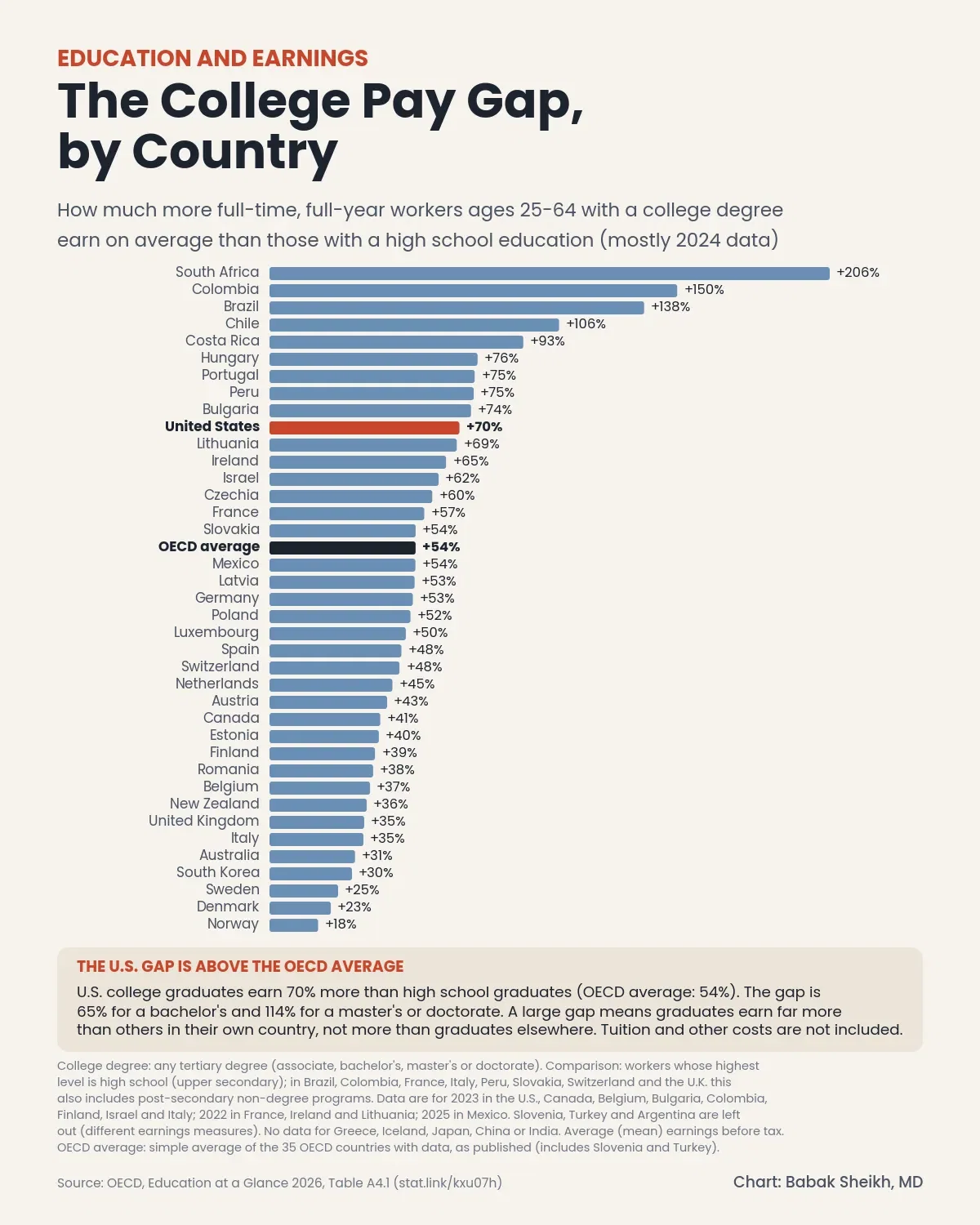
How much more do college graduates earn than people with a high school education? The answer depends a lot on the country.
The chart uses OECD data for full-time, full-year workers ages 25 to 64 in 38 countries, mostly from 2024.
Key Takeaways
- Across OECD countries, workers with a college degree earn 54% more on average than those with a high school education.
- The U.S. gap is larger, at 70%. It is 65% for a bachelor's degree and 114% for a master's or doctorate.
- The gap is widest in South Africa (206%), Colombia (150%) and Brazil (138%).
- It is narrowest in Norway (18%), Denmark (23%) and Sweden (25%).
- A large gap means graduates earn far more than others in their own country, not that they earn more than graduates elsewhere. Tuition and other costs are not included.
Note: College degree means any tertiary degree (associate, bachelor's, master's or doctorate). Earnings are average (mean) earnings before tax. Data are for 2023 in the U.S. and several other countries, 2022 in France, Ireland and Lithuania, and 2025 in Mexico. Slovenia, Turkey and Argentina are left out because they measure earnings differently. The OECD average is the simple average of the 35 OECD countries with data.