
Where Data Tells the Story
© Voronoi 2026. All rights reserved.

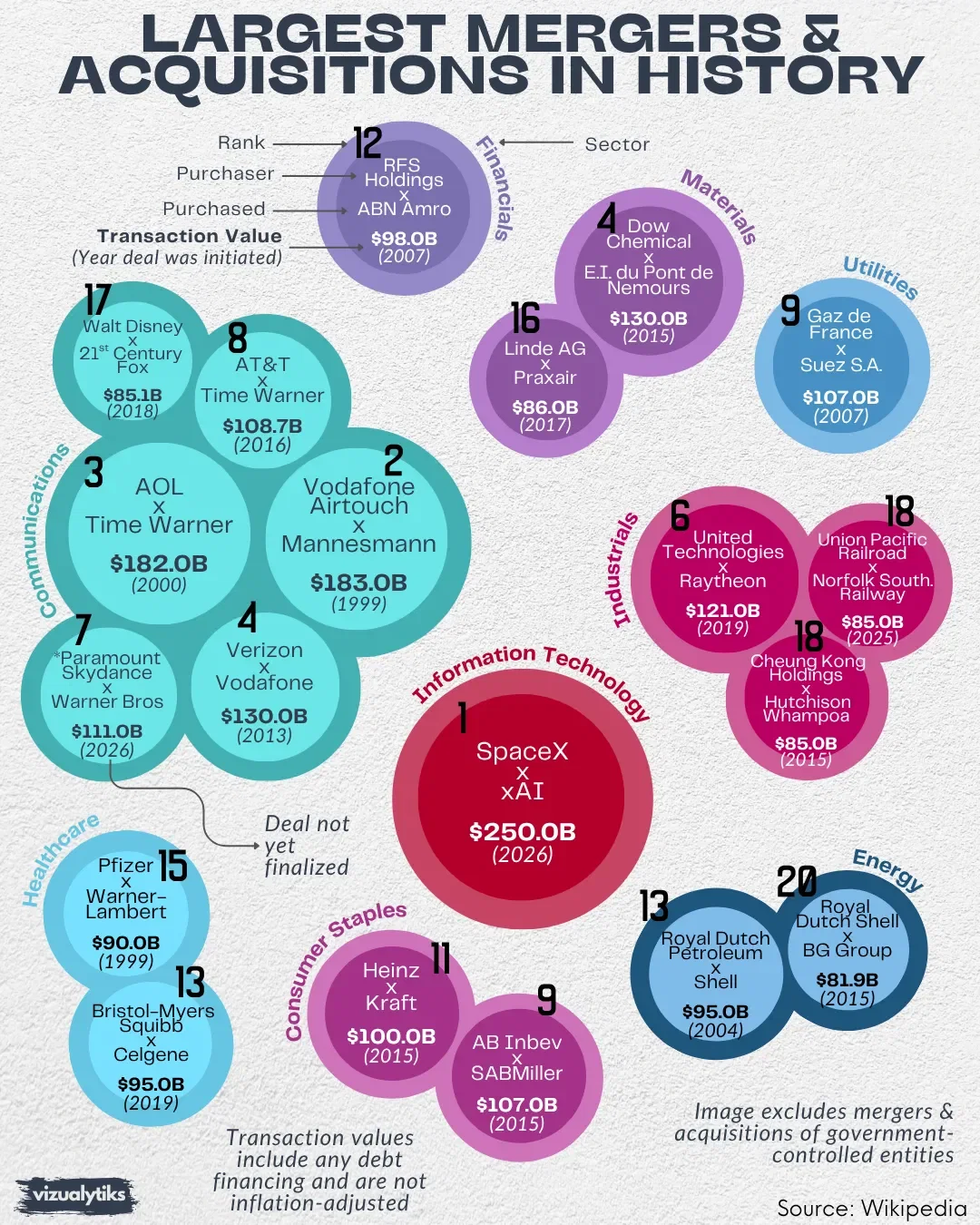
The biggest mergers or acquisitions in history tend to happen when industries are going through major shifts. From telecom consolidation during the internet boom to large tie-ups in energy, materials, and consumer goods, these deals often reflect companies trying to gain scale, control supply chains, or respond to technological disruption. Transactions like Vodafone–Mannesmann ($183B) and AOL–Time Warner ($182B) defined the early 2000s, while deals such as Dow–DuPont and AB InBev–SABMiller showed how consolidation reshaped chemicals and consumer staples.
More recently, SpaceX’s acquisition of xAI for $250B highlights how the focus of mega-deals is shifting toward technology and data infrastructure. The transaction values the combined entity at over $1T, reflecting the growing convergence of artificial intelligence, space infrastructure, and large-scale data networks.
Still, not every blockbuster deal delivers on its promise. History shows that some of the biggest mergers have struggled to achieve their intended synergies with the AOL–Time Warner merger being a prime example. Announced at the height of the dot-com boom, the combined company eventually recorded a $99B write-down in 2002, one of the largest corporate losses ever, after the bubble burst. As industries continue to evolve with AI, defense technology, digital infrastructure, and the energy transition, the next wave of mega-deals will likely emerge where these forces intersect, though their long-term success is never guaranteed.