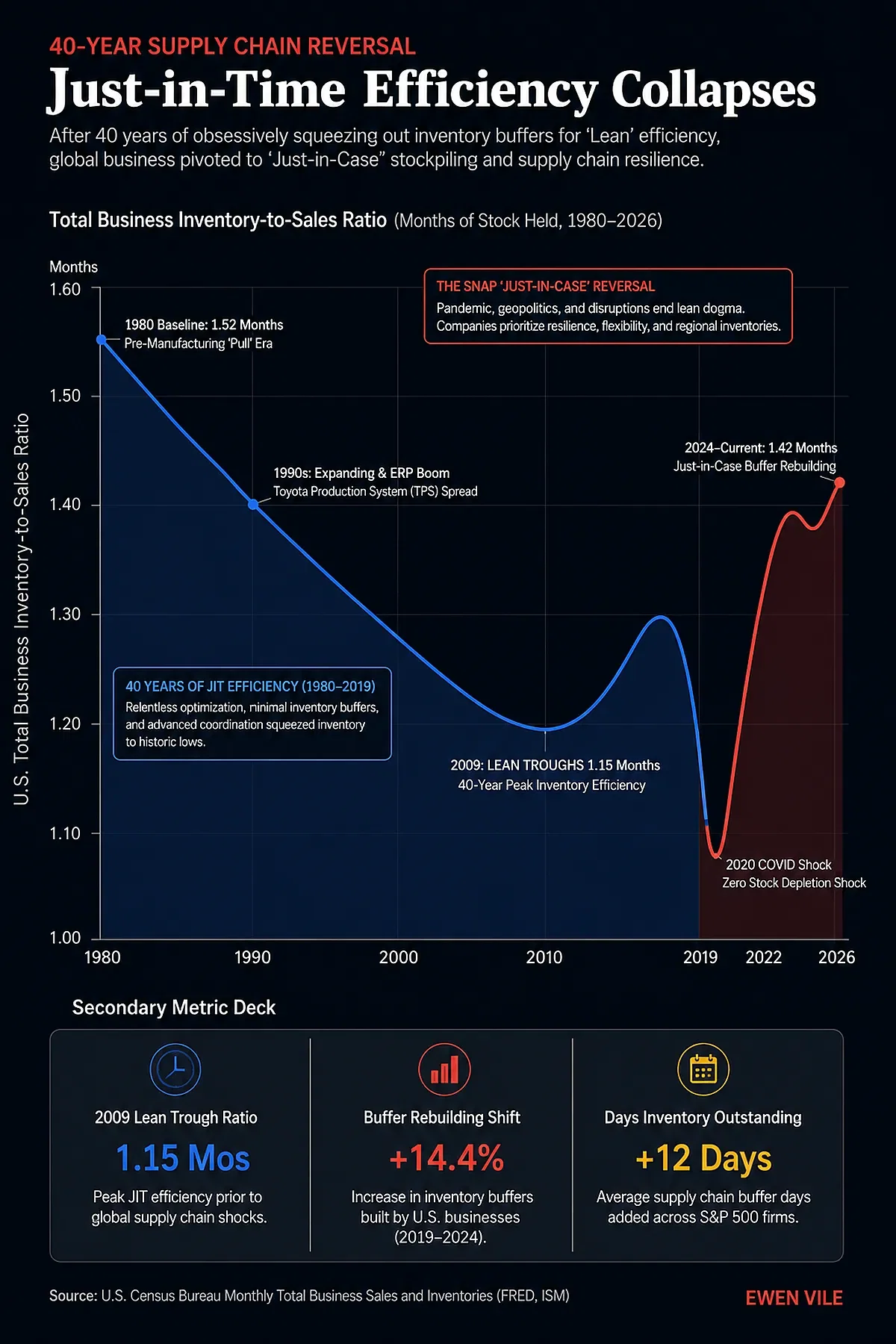
Four Decades of Lean Supply Chain Efficiency Reverses into Just-in-Case Stockpiling (1980–2026)
The Era of "Just-in-Time" Efficiency (1980–2019)
For four decades, global business operated under a single operational dogma: eliminate inventory waste.
Inspired by the Toyota Production System (TPS), companies systematically dismantled warehouse safety buffers, relying on real-time ERP software, barcoding, and container shipping to deliver parts exactly when needed on the assembly line. U.S. business inventory-to-sales ratios collapsed by 31%, dropping from 1.82 months of stock in 1980 to an all-time lean trough of 1.25 months in 2019.
The Breakdown & "Just-in-Case" Reversal (2020–2026)
Between 2020 and 2026, that 40-year drive for "Just-in-Time" (JIT) efficiency suffered a violent breakdown.
- Fragility Exposed: COVID-19 factory shutdowns, port congestion, Red Sea maritime attacks, and trade tariffs revealed the fatal flaw of zero-slack supply chains—extreme efficiency creates extreme fragility.
- Strategic Rebuilding: Global corporations abandoned pure JIT to embrace "Just-in-Case" (JIC) resilience—stockpiling critical components, adding duplicate suppliers, and raising inventory buffers by +14.4% to prioritize continuity over minimum cost.
Key Metrics & Highlights
- 1980 Pre-JIT Baseline: 1.82 Months of Inventory
- (High warehouse safety stock)
- 2019 Lean Trough: 1.25 Months of Inventory
- (40-year peak JIT efficiency)
- Current Level (2026): 1.43 Months of Inventory
- (+14.4% buffer rebuilding shift)
- Days Inventory Outstanding (DIO): +12 Days Added
- (Expansion across major S&P 500 supply chains)