
Countries by Number of Starbucks Locations
Venti ambitions
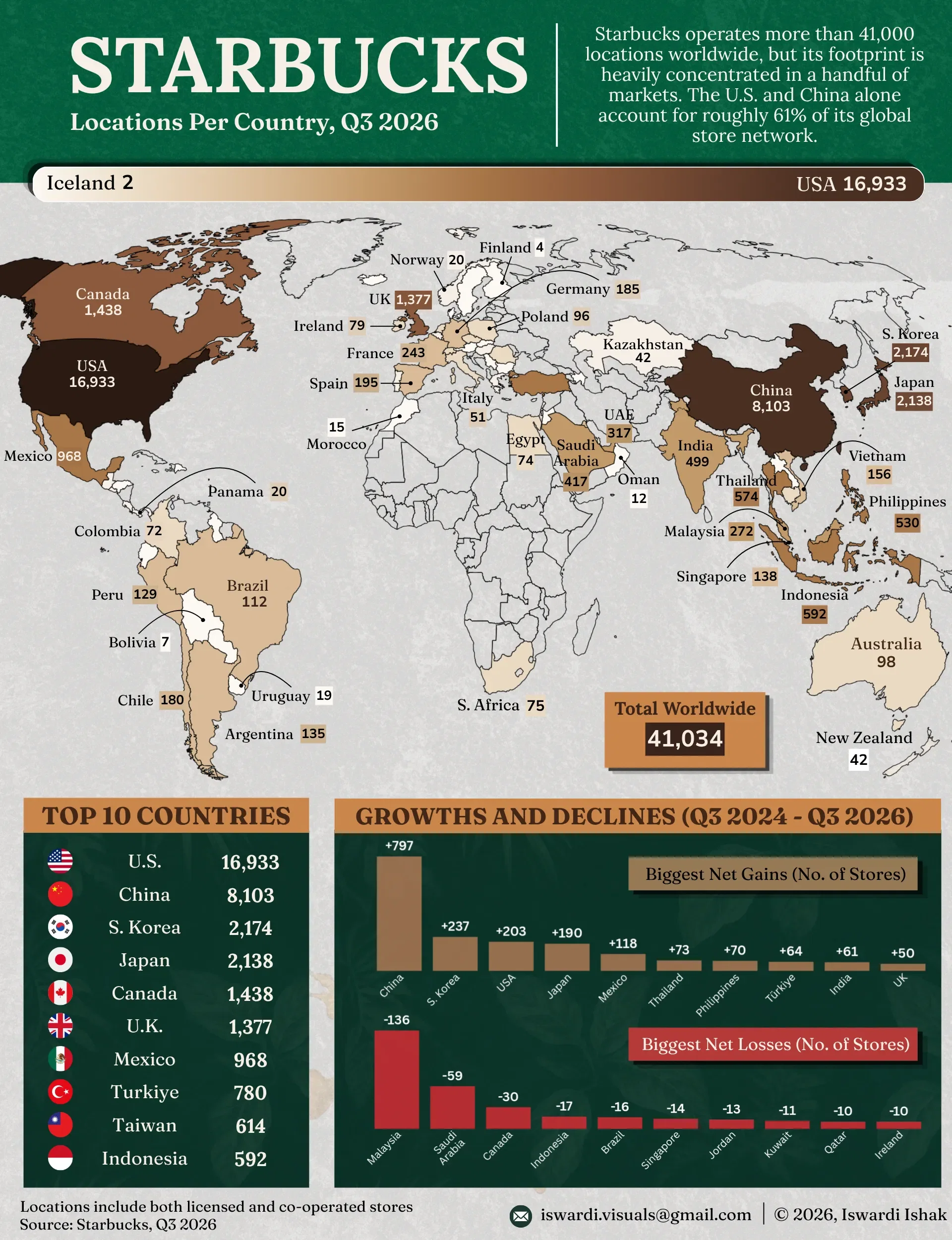
Few brands are as inescapable as the green siren. By the third quarter of 2026 Starbucks counted 41,034 outlets worldwide, according to the company’s own figures. Yet the map of where those shops sit, and where they are multiplying or vanishing, says more about the chain’s fortunes than the headline number does.
Start with concentration. America alone accounts for 16,933 stores, roughly 41% of the total, a share that has barely budged even as the company has talked up its global reach. China comes second with 8,103, nearly half the American tally and far ahead of anyone else. Together the two countries hold about three-fifths of all Starbucks shops. South Korea (2,174) and Japan (2,138) follow, then Canada (1,438) and the UK (1,377). Rich Asia is a good deal more caffeinated than rich Europe: South Korea, with a population of about 52m, has more Starbucks than France, Germany, Italy and Spain combined by a wide margin. Those four countries together manage only 674.
The more interesting story is the change over the past two years. Between Q3 2024 and Q3 2026, China added 797 shops, more than three times the gain of the next-best performer. That is striking given the gloom that has hung over Chinese consumer spending, and given the local competition. Home-grown rivals such as Luckin Coffee have expanded at a ferocious pace and sold cups at a fraction of Starbucks’s prices. The American firm has evidently decided that retreating from such a market is not an option. South Korea (+237), America (+203) and Japan (+190) round out the leaders.
The losses are a more varied lot. Malaysia suffered the steepest fall, shedding 136 outlets, followed by Saudi Arabia (-59) and Canada (-30). The Malaysian and Saudi cases share a feature: both are Muslim-majority markets where Starbucks has been caught up in consumer boycotts linked to the war in Gaza. Jordan (-13), Kuwait (-11) and Qatar (-10) also appear on the list of contractions. Malaysia's neighbours; Indonesia (-17) and Singapore (-14) lost ground too, though in Indonesia the chain still has 592 shops. Canada’s decline is the odd one out, a mature, wealthy market where the firm appears to be pruning rather than fleeing.
Two cautions are in order. The figures count licensed and co-operated shops alongside company-run ones, so they say nothing about profitability. A licensed kiosk in an airport is a different beast from a flagship in Shanghai. Net changes also hide churn: a country that gains 50 shops may have opened 150 and closed 100. And store counts are a crude proxy for sales. Starbucks has lately spoken of shrinking underperforming American outlets to improve margins, which is consistent with the modest growth at home.
Still, the picture is clear enough. Starbucks is a firm whose centre of gravity is shifting east, and whose reputation can be punctured by politics far from any coffee bean. Its bet on China is large and, so far, costly in competitive terms. Its exposure in the Middle East and parts of South-East Asia show how quickly a global brand can turn into a local liability. Forty-one thousand shops make for an impressive empire but they do not make it an immovable one.
