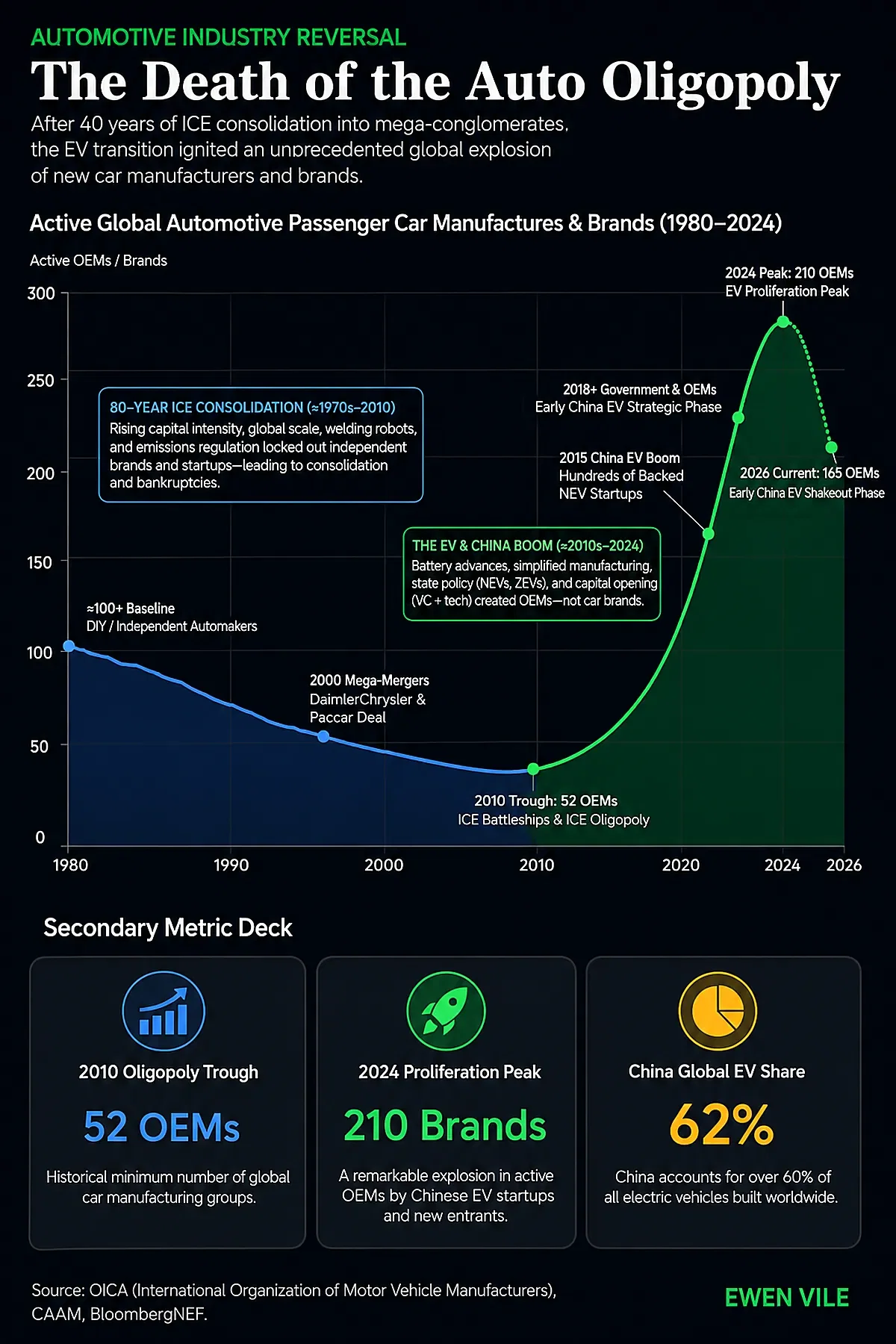
Four Decades of Automotive Consolidation Reverses into an Unprecedented EV Manufacturer Explosion (1980–2026)
The ICE Consolidation Era (1980–2010)
For four decades, the global automotive industry operated under a relentless law of consolidation.
High internal combustion engine (ICE) R&D CapEx, strict crash safety rules, and massive manufacturing scale forced dozens of independent carmakers into bankruptcy or absorption by mega-conglomerates (GM, VW Group, Stellantis/FCA, Toyota).
By 2010, the number of active global passenger car manufacturers and major brands had collapsed by 57% to a historical trough of just 52 operating entities. Entry by a new car company was considered nearly impossible.
The EV Proliferation Boom (2010–2026)
Between 2010 and 2026, the transition to Electric Vehicles (EVs) completely shattered that 40-year oligopoly:
- Lower Barriers to Entry: Electric powertrains require significantly fewer moving parts than traditional ICE engines.
- Massive Market Entry: Driven by heavy Chinese industrial policy, software integration, and venture capital, over 130 new automakers and EV brands entered the market.
- Peak & Shakeout: By 2024, active global car brands reached an all-time peak of 210—4x more manufacturers than at the 2010 trough—before entering an early price-war shakeout phase.
Key Metrics & Highlights
- 2010 Oligopoly Trough: 52 Active OEMs/Brands
- (Lowest manufacturer count in modern auto history)
- 2024 Proliferation Peak: 210 Active Brands
- (4x surge driven by Chinese EV startups and tech entrants)
- Current Run-Rate (2026): 185 Active Brands
- (Early consolidation shakeout underway)
- China Dominance: 62%+ Global EV Production
- (Produces over 62% of all electric vehicles manufactured worldwide)