
Where Data Tells the Story
© Voronoi 2026. All rights reserved.

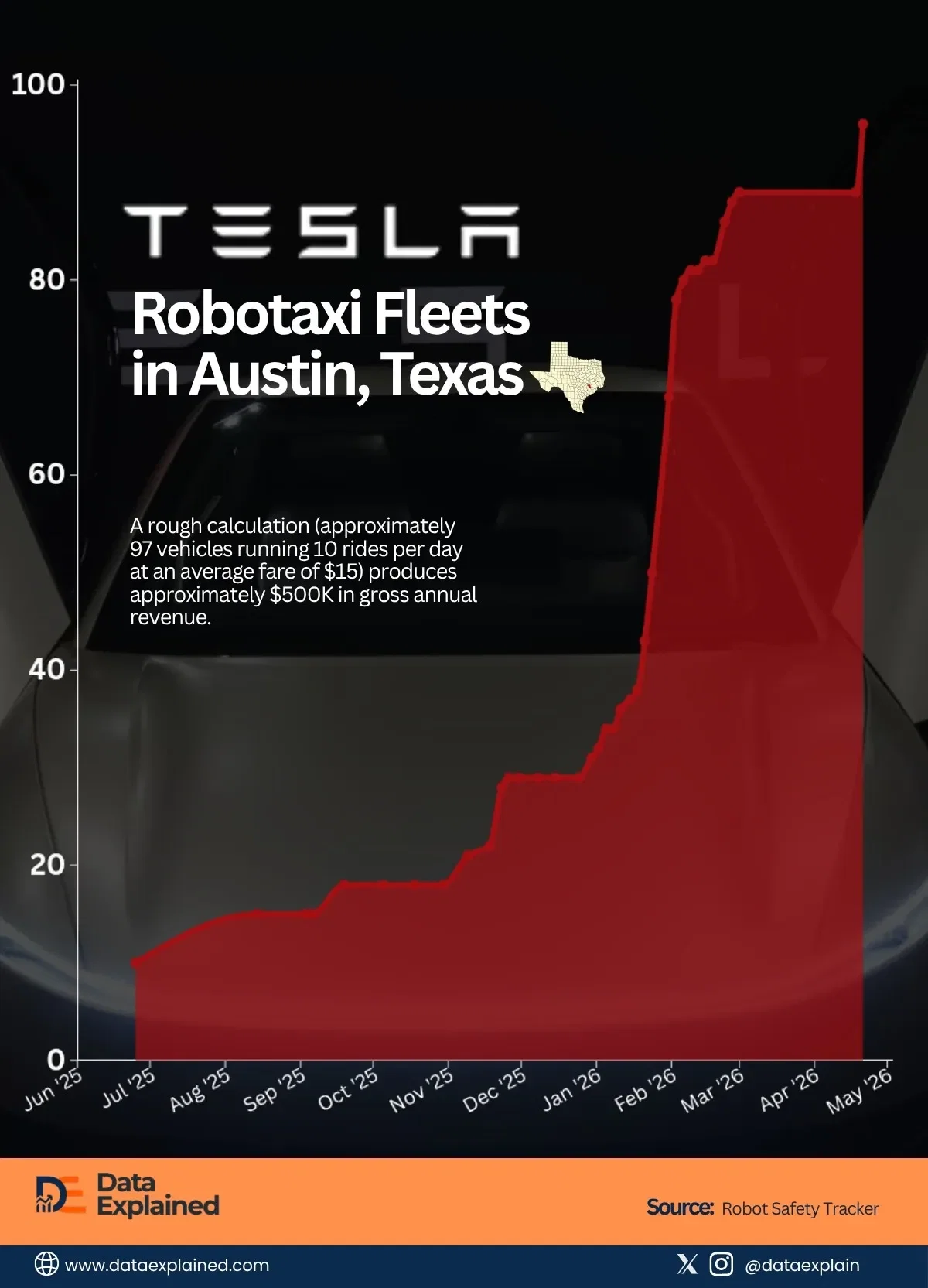
Tesla’s self-driving taxi service has approximately 97 vehicles operating in Austin, Texas.
Elon Musk wants the service running in a dozen or so states by the end of 2026.
Those two facts, placed side by side, define the distance between where Tesla’s Robotaxi is and where its CEO says it is going.
Robot Safety Tracker, a third-party tool that monitors Tesla’s autonomous vehicle deployment, has logged every addition to the Austin Robotaxi fleet since the service launched.
Ten months later, the fleet stands at approximately 97 vehicles.
We use the data to show a granular, publicly available picture of how Tesla’s autonomous taxi operation has actually developed (not as announced, but as deployed).
Since that January surge, growth has been gradual.
The fleet reached approximately 85 to 90 vehicles through February and March before approaching its current level of approximately 95 to 97 vehicles.
It has held near that threshold for several weeks without crossing 100.
Tesla has already expanded the service to Dallas and Houston, adding to its presence in Austin.
Musk stated on the April 22 earnings call that the goal is to reach a dozen or so states by year’s end.
The Austin trajectory, ten months to reach approximately 97 vehicles, is the operational template for what each new city launch looks like.
If Dallas and Houston follow the same pattern, a meaningful multi-city fleet size will take the better part of a year per market to develop.